
A purchase request form should collect the requester, the item and quantity needed, the intended use, the reason for buying, the estimated cost, the requested delivery date, and supporting references. It gives a coordinator enough information to review a need before an order is placed. Submitting the form does not itself approve spending or send an order to a supplier.
This guide provides a practical field template and examples of purchase justifications. A fictional meeting-room monitor request shows how to make the specification, cost assumptions, and review handoff clear without turning an intake form into a procurement system.
Define what the request starts
The purpose of a purchase request is to explain what is needed, why it is needed, and when it is needed. A product name or link may identify an item, but it rarely explains the business need or which features are essential. That missing context becomes another email exchange for the coordinator.
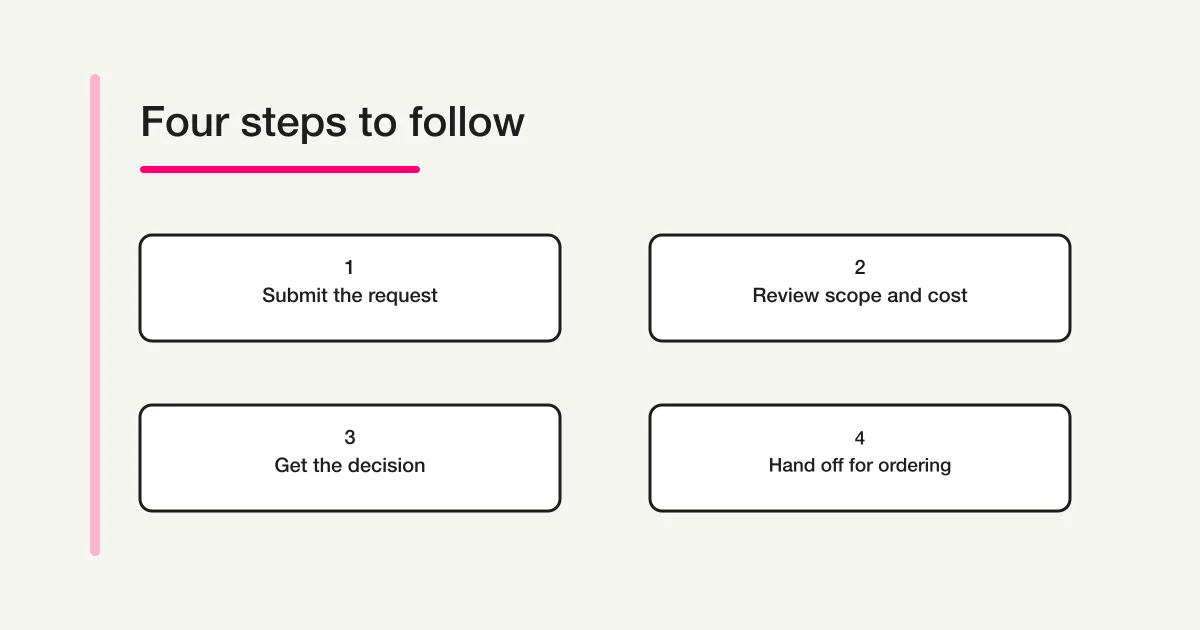
Separate request receipt, review, approval, order placement, and receipt of goods. A completion message should describe the stage the applicant has actually reached. “Your purchase request has been received. A coordinator will review it and contact you” is clearer than a message suggesting that a purchase is already confirmed.
| Stage | Main questions | Example record owner |
|---|---|---|
| Request | What item, specification, quantity, purpose, cost, and delivery need? | Requester submits the intake form |
| Review and approval | Is the need justified, and are the conditions acceptable under internal rules? | Coordinator follows the organization's approval process |
| Order placement | What approved item is being ordered, from whom, and on what terms? | Authorized buyer maintains the purchase record |
| Goods receipt and payment | Do the delivery, condition, and invoice agree with the order? | Receiving staff and finance update their official records |
Colorado State University's requisition guidance distinguishes an internal purchase requisition from a purchase order. Its specific rules apply to that university. For your own intake design, the useful distinction is between collecting an internal need and making an external purchasing commitment.
If your organization already has a procurement or accounting system, decide how the form will hand information to that process. A second intake page should not become a competing approval register. Staff need to know where the authoritative decision and order status will be recorded.
Purchase request form template
The following fields are a starting point for collecting requests before ordering goods. Adapt them to your organization's policies and remove fields nobody will use. Requesters should not have to invent an approval code, budget balance, or accounting classification they do not know.
| Field | Suggested input | Purpose or example |
|---|---|---|
| Requester name | Short text | Person who can answer follow-up questions |
| Department and contact | Choice and email | Internal route for review and replies |
| Item requested | Short text | Meeting-room monitor, with a recognizable description |
| Required specification | Short or long text | Location, connection needs, size, or other essential conditions |
| Quantity and unit | Number and unit | One unit; distinguish units, packs, and sets |
| Intended use and justification | Long text | Current problem, use case, and reason the item is needed |
| Estimated amount and currency | Number with explanation | State tax treatment and whether shipping is included |
| Requested delivery date | Date | When the item needs to arrive, rather than just the event date |
| Quote or product reference | URL or optional supporting material | Information staff can use to check the model and conditions |
| Additional notes | Optional long text | Alternatives, uncertainties, or questions for the coordinator |
Separate the item name from the required specification. If someone names a particular model, ask which characteristics matter and whether an equivalent product would work. The goal is to explain the requirement, not to add a long technical questionnaire to every request.
When the paying department matters, use labels applicants recognize. Asking them for a budget balance does not remove the need for an authorized budget check. Keep the approval authority, account validation, and permission to place an order within the organization's established procedures.
For several items, preserve the relationship between description, quantity, unit, and estimate. A paragraph containing several product links and a single unexplained total is difficult to verify. Choose a structure that staff can read reliably in the submitted response, and split unrelated requests when that makes review clearer.
Write a useful purchase justification
A helpful justification describes the current situation, the intended use, and the important requirements. It gives the reviewer something concrete to assess. It does not need an impressive financial forecast when the requester has no evidence for one.
A justification that needs more detail:
We would like to buy a monitor for meetings because it would be useful.
A version that gives the reviewer a starting point:
We request one display for meeting room 2 so participants can view the same document during discussions. At present, each person opens the material on a separate laptop, which makes it difficult to point to the same section. The display needs to fit the room and connect to the computers we use. Before buying, we would also like the coordinator to check whether an existing display can be moved to this room.
This is a fictional example, not a measured outcome. There is no need to claim that meetings will become twice as fast or that the purchase will deliver an unverified return. The current problem, use case, and essential conditions are enough to begin an informed review.
Mention whether the need is recurring or limited to one event. That can change the alternatives worth considering. Borrowing an existing item or arranging a temporary rental may be appropriate for a short period. If the request is to borrow equipment rather than buy it, use a separate intake such as the equipment loan request template, which concerns collection and return dates.
Make estimated costs comparable
An amount such as “50,000” leaves several unanswered questions. Which currency does it use? Is tax included? Does it cover shipping, installation, and the accessories needed for the item to work? Keep those assumptions beside the estimate so the reviewer can interpret it.
| Estimated component | Fictional example |
|---|---|
| Monitor | One unit, JPY48,000 including tax |
| Shipping | JPY2,000 including tax |
| Estimated total | JPY50,000 including tax |
| Still to be checked | Installation and any additional connection accessories |
| Reference checked on | The date the requester actually checked the price or quote |
These are invented amounts used to illustrate the field structure. They are not a supplier quotation, a market-price claim, or a tax calculation. If shipping is unknown, record that uncertainty rather than presenting the displayed total as the final purchase price.
A product-page price and a formal organizational quotation can have different conditions. Ask the requester to identify what the reference covers, especially when several quantities or accessory options are available. A coordinator should be able to tell whether the estimate is provisional and what remains to be verified.
Provide a reference that another authorized staff member can open. A personal shopping cart or an account-specific link may not show the same item to the reviewer. Before sharing a URL, check that it does not contain access credentials or personal information.
If a quotation is attached, make sure it is appropriate to share and restrict access to the people who need it. Requirements for formal quotations, competing offers, or supplier selection vary between organizations. A field template does not establish those purchasing rules or replace a procurement team's judgment.
Distinguish delivery needs from the date of use
A requested delivery date should leave room for receiving, installation, and checking the equipment. Asking only for an event date can hide that preparation time. A short explanation of the activity the item is needed for helps the coordinator assess the timing.
SUNY's purchase requisition procedures ask requesters to specify when an order is needed if there is a particular required date. This is an example of that university's process, not a universal deadline. In your own organization, explain how normal approval and ordering lead times affect when a request should be submitted.
Give urgent needs a defined contact route. Choosing a date close to today does not automatically alert the right person or accelerate approval. Explain how applicants should raise a time-sensitive issue while keeping the normal request record complete.
Also distinguish a preferred date from a confirmed supplier commitment. The requester can state what is needed. The buyer still needs to verify availability, delivery arrangements, and any conditions before making promises about arrival.
Draft a purchase intake form in FORMLOVA
FORMLOVA lets you describe the information you need in a supported AI chat and create a form draft. Start with fictional items and amounts, then review both the questions and the response view. The form creation guide explains the overall process.
You can use a prompt like this:
Draft an unpublished internal form for collecting purchase requests. Include requester name, department, contact email, item description, required specification, quantity and unit, intended use and justification, estimated amount and currency, tax and shipping assumptions, and requested delivery date. Make the reference product URL and additional notes optional. Use a fictional meeting-room monitor as the example. Explain that submission is not purchase approval or an order. Make the completion message say the request has been received and a coordinator will contact the requester after review. Do not publish, place orders, or send emails.
Collect purchase needs in fields your coordinator can review
FORMLOVA's Free plan includes form creation and publishing, response collection, search, basic analysis, and CSV/Excel export. Start with an unpublished draft for collecting needs before an order is placed.
Register free to draft a purchase request form
Register, confirm your email, connect FORMLOVA to a supported AI chat, and use the prompt above. Check your AI client's connection support, access requirements, subscription, and any separate charges with that provider.
Review required fields, units, and the wording beside estimated amounts. If a product URL is optional, check that the applicant can still explain the essential specification and the need. Unknown information should remain recognizable as something to confirm rather than be filled with a guessed answer.
Response search and CSV/Excel export can help the coordinator examine submitted needs. Intake does not automatically allocate a budget, approve spending, place an order, make a payment, or update a purchase register. Keep the official approval and purchasing records in the system or process responsible for those actions.
Review requests and handle changes clearly
The coordinator checks whether existing equipment or another pending request could meet the need, whether the specification and quantity match the justification, and whether cost assumptions are clear. Record the result and any outstanding questions where the next person responsible can find them.
A change to the model, amount, or quantity after approval may need another review under internal rules. Ask the requester to identify the original request and explain what changed. Do not let the form itself decide that a small change is exempt from approval. If an order already exists, the authorized buyer must also check whether it can be changed or cancelled.
Prevent duplicate orders by naming who is responsible for ordering. A requester and a coordinator should not independently buy the same item because each assumes the other has not acted. Define where order status and any order reference are checked before another purchasing action is taken.
Similar submitted responses do not prove a duplicate. A second response could be a correction, a revised quantity, or a different department's need. Confirm its purpose before discarding information, and preserve the relationship between the original request and the agreed revision.
Test desktop, mobile, and the staff handoff
Use dummy names and a contact route you control. Submit a complete request, then examine it from the coordinator's perspective. Questions that look clear in the form must also remain interpretable in the received response.
| Test | What to check |
|---|---|
| Normal request | Item, specification, quantity, reason, and estimated cost remain distinguishable |
| Uncertain amount | The applicant can explain unknown tax or shipping conditions |
| Missing required information | Instructions identify what needs correcting |
| Mobile layout | Long item names, references, and justifications can be read and entered |
| Completion message | Receipt is not described as approval or an order |
| Staff handoff | The reviewer and the official approval/order record are defined |
Review who can access the form and who can view the responses. Sharing a link only with staff is different from applying an access restriction. Choose the publication scope and permissions that fit your organization's requirements before sending the form to applicants.
Test the process after intake as well. Someone needs to notice a new request, ask follow-up questions when necessary, and move the reviewed information into the approved purchasing process. A clear questionnaire helps that work, but it does not assign the responsibility on its own.
Frequently asked questions
Can the same form collect expense claims after purchase?
Pre-order requests and post-payment reimbursement require different evidence and decisions. For purchases already paid for by an employee, use a separate intake such as the expense reimbursement form guide, which concerns receipts and claim review. Keeping these entry points distinct makes the current stage easier to understand.
Is a product URL enough?
Prices and page content can change. Keep the purpose, essential specification, quantity, and estimated-cost assumptions in the request as well. A reference link helps the reviewer inspect the proposed item; it should not be the only explanation of what is being requested.
Can this replace our paper or Excel requisition?
You can move the intake fields online, but that does not automatically replace internal authorization procedures. Review the existing document and separate applicant fields from staff-only records. The form field examples guide can help you choose suitable question types and required fields.
Disclosure and verification
Written by FORMLOVA's developer after checking the plan definition and the cited primary sources on October 30, 2026. The monitor, amounts, and request examples are fictional. University pages illustrate their own procedures; this guide does not turn those procedures into general procurement rules or legal requirements. Adapt the template to your organization's approval standards and purchasing process.
