
A client intake form organizes goals, budget range, timing, and missing information before the first discussion. Separate it from post-contract billing and access setup, and do not make unfinished documents a condition of initial contact.
Last updated: July 2, 2026
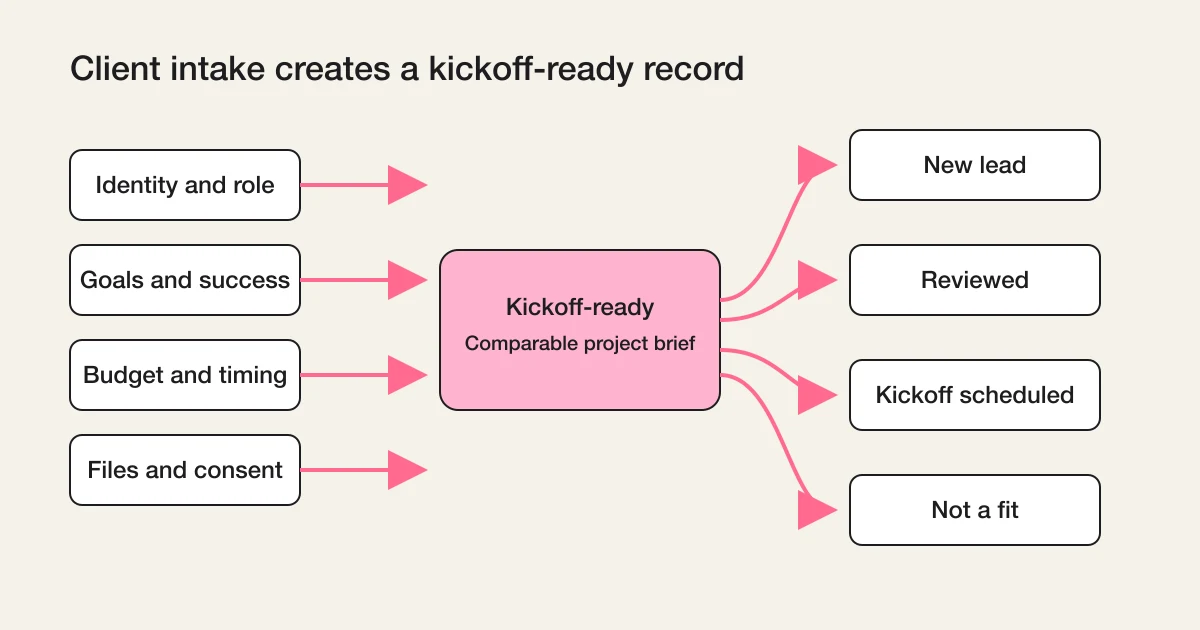
A client intake form should collect five things: who the client is, what outcome they want, the constraints around that outcome, the materials you need to start, and consent plus a clear next step.
That is the whole checklist. In field terms, it means contact and company basics, goals in the client's own words, budget range and timeline, file uploads for briefs and assets, and a privacy consent checkbox with an honest promise about what happens after submit.
But the form is only half of client intake. The other half is what your team does in the hours after submission: assign an owner, set a status, chase missing items, and schedule the kickoff. A beautiful intake form with no workflow behind it produces the same outcome as a messy email thread, just more politely.
This guide covers both halves. First the fields, with a reusable client intake form template that works across agencies, consultants, professional practices, and freelancers. Then the kickoff workflow state that turns a submission into a started engagement.
Client intake is one branch of a larger discipline. If you want the full picture of what happens to form responses after they arrive, the Contact Form Operations Guide is the parent map. This article stays on the intake branch.
What a Client Intake Form Is, and What It Is Not
A client intake form is the structured entry point for a new engagement. It runs before or at the very start of the work relationship, and its job is to replace the first scattered round of calls, emails, and chat messages with one complete, comparable record.
It is not a contact form. A contact form invites anyone to say anything. An intake form assumes a serious prospect or a signed client and asks for the specifics work depends on.
It is not a new client onboarding form either, although the two are often confused. The difference is timing and content:
| Form | When it runs | What it asks |
|---|---|---|
| Client intake form | Before or at the start of the engagement | Goals, scope signals, budget range, timeline, decision process, initial files |
| New client onboarding form | After the agreement is in place | Billing details, points of contact, account access, brand assets, meeting cadence, tool preferences |
Intake decides whether and how to start. Onboarding operationalizes a start that has already been decided. Many teams merge them into one long form, and that is usually a mistake: prospects who have not committed yet will abandon a form that asks for billing contacts, and committed clients get annoyed re-answering qualification questions. Two shorter forms at two moments beat one long form at the wrong moment.
One more boundary. If your intake is specifically a web design hearing that should turn into wireframes, that specialized workflow has its own article: Turn Site Design Hearings into Forms. This guide stays industry-neutral.
The Five Blocks Every Client Intake Form Needs
Whatever your industry, the intake form has the same skeleton.
| Block | What it captures | Why it matters at kickoff |
|---|---|---|
| Identity | Name, company, role, contact channel | You know who you are talking to and who can decide |
| Goals | The outcome in the client's own words, success criteria | The engagement has a target before the first meeting |
| Constraints | Budget range, timeline, hard deadlines, known blockers | You can scope honestly instead of discovering limits mid-project |
| Materials | Briefs, existing documents, brand assets, examples | Work can start without a "please send the files" email chain |
| Consent and next step | Privacy consent, how their data is used, what happens after submit | The client knows the process is professional and moving |
Everything else is an industry-specific add-on. Resist the urge to ask every question you might ever need. Each additional required field costs completions, and an abandoned intake form tells you nothing at all.
A working rule: the intake form collects what the kickoff meeting depends on. Anything you could comfortably ask in the kickoff itself stays out of the form.
A Client Intake Form Template, Field by Field
Here is a cross-industry client intake form template. Sixteen fields across five pages; review the length and required settings for your actual intake.
Page 1 -- About you
| Field | Type | Required |
|---|---|---|
| Full name | Text | Yes |
| Company or organization | Text | Yes |
| Role | Dropdown (owner, executive, manager, specialist, other) | Yes |
| Yes | ||
| Preferred contact channel | Dropdown (email, phone, video call) | No |
Page 2 -- Goals
| Field | Type | Required |
|---|---|---|
| What outcome do you want from this engagement? | Long text | Yes |
| How will you know it succeeded? | Long text | No |
| What have you already tried? | Long text | No |
Page 3 -- Constraints
| Field | Type | Required |
|---|---|---|
| Budget range | Dropdown of ranges | Yes |
| Desired start | Dropdown (as soon as possible, within a month, within a quarter, exploring) | Yes |
| Hard deadline, if any | Date | No |
Page 4 -- Materials
| Field | Type | Required |
|---|---|---|
| Brief, requirements document, or anything written | File upload | No |
| Brand assets, examples, or references | File upload | No |
| Links we should look at | Text | No |
Page 5 -- Consent and confirmation
| Field | Type | Required |
|---|---|---|
| Privacy consent | Checkbox with a link to your policy | Where required |
| Anything else we should know? | Long text | No |
Three design choices in this template do most of the work.
Multi-page beats single-page for intake. Sixteen questions on one screen looks like an exam. The same questions across five short pages, each with a clear theme, feel like a conversation. The order also mirrors how you will read the response: who, what, within which limits, with which materials.
Dropdowns wherever answers need to be comparable. Role, budget range, and desired start are dropdowns, not free text. Free-text budget answers give you "flexible," "depends," and "let's discuss," which are three ways of saying nothing. Ranges give you data you can route on: a below-minimum range can trigger a polite decline template, and a top-tier range can notify a senior person immediately.
Materials are optional at intake. Clients often do not have the brief ready on the day they reach out. If file fields are required, they postpone the whole form until "the documents are ready," and many never come back. Accept the submission, then chase files as a tracked follow-up item. Missing files are a workflow state, not a validation error.
Asking About Budget Without Losing the Client
Budget is the field teams are most tempted to drop, and dropping it is almost always wrong. An intake without a budget signal forces a full proposal cycle just to discover a 10x mismatch.
The problems with budget questions are real, though. A required free-text "What is your budget?" reads as "quote me a number I can hold you to," and clients either inflate, lowball, or abandon.
Three adjustments fix most of it.
First, use ranges, and make the ranges honest. The lowest range should sit at or just below your actual minimum engagement. If your projects start at a certain level, a range beneath it plus an "exploring options" choice lets mismatched prospects self-identify without wasting anyone's time.
Second, explain why you are asking, right in the field description. One sentence is enough: "A range helps us propose something realistic instead of guessing." Context turns an interrogation into collaboration.
Third, if your sales motion truly cannot ask for budget upfront, keep the field but make it optional, and treat an empty budget as a routing signal: the owner asks about it in the first reply instead. The point is not to force an answer. The point is to make sure the question cannot be forgotten.
Files, Assets, and Access
Materials are where intake forms earn their keep. Every service business knows the ritual: the kickoff happens, everyone agrees to start, and then a week evaporates while briefs, logos, exports, and access credentials trickle in over email.
Put file collection in the intake form, with two rules.
Ask for documents, never for secrets. Briefs, requirement documents, brand assets, screenshots, and reference material belong in an upload field. Passwords, API keys, and login credentials never do, on any form. Access to client systems should be granted through each tool's own invitation or sharing mechanism after the engagement starts, and the onboarding form can ask "who on your side will grant access?" instead of asking for the credentials themselves.
Accept common formats generously. If a client's brief is a PDF, a Word file, or a slide deck, the form should take all of them. Overly strict format allowlists produce failed uploads, and a failed upload at the last step is where intake submissions go to die. Keep required-format constraints for cases where a downstream process genuinely depends on them.
In FORMLOVA, file upload fields are available on the Standard plan and above, and uploaded files stay attached to the response so the owner reviews the goals, the budget, and the brief in one place instead of reconciling a form entry with an email attachment.
For requests where the document itself is the product, such as sending a brochure or whitepaper to the requester, that is a different form with different follow-up logic: see the Material Request Form Guide.
The Kickoff Workflow State: What Happens After Submit
After submission, record an owner candidate, what has been reviewed, missing material, and the next contact date. These are business facts, not proof that a meeting has been booked or a reply has been sent.
| Business stage | Evidence needed before advancing |
|---|---|
| Received | A saved intake response |
| Owner confirmed | A named person has accepted responsibility |
| Reviewed | Goals, budget, timeline, and available materials checked |
| Waiting for material | A specific missing item and agreed next check |
| Kickoff scheduled | Confirmed meeting details in the scheduling record |
FORMLOVA response status is New, In progress, Resolved, or Spam. Keep the business stage in existing notes, tags, or a separate project record. Read current notes and tags immediately before appending so an update does not overwrite prior context. CSV exports contain form fields and submission time, not internal status, notes, tags, or response-ID columns.
Use the response-status guide for handling progress and the post-submit workflow guide for the wider sequence. Custom auto-reply wording requires Standard or above; use only a response deadline your team has verified.
Building the Intake Form in FORMLOVA
Start with the no-upload example below. After registration and email verification, connect a supported AI client, save a draft, and review the fields, required settings, data-use wording, and thank-you page on mobile and desktop. AI-client access and costs are separate.
Publish only after the requested review. A draft preview does not save responses, so verify storage using a reviewed test publication and fictional data. Search saved responses, confirm an ID before changing status, then fetch it again.
Files and custom replies require Standard or above. Collect briefs and assets through approved file types when needed; never collect passwords or API keys. Grant system access through the target tool’s invitation mechanism. See the setup guide for the connection steps.
Test a web-project intake without uploads
Draft an intake that prepares a first project discussion. Keep it distinct from a quote request and allow unknown budgets or missing documents rather than blocking the initial conversation.
Suggested request; this is not an executed configuration or result:
Draft a web-project intake with required name, email, and project goal. Company, budget band including Not decided, desired timing, and a reference URL are optional. Do not request uploads, passwords, or access tokens. Show required settings and the thank-you page before publication.
Submit fictional requests with an unknown budget and with a desired timeline. Find the goal and budget, confirm a response ID, mark it In progress, then fetch it again. Read existing notes before appending missing items or an owner candidate. Uploads and custom replies require Standard or above. The Free trial covers intake without uploads, search, status review, and CSV.
Start with this form on Free
Draft the fields above and test fictional saved responses, search, status review, and CSV. Evaluate uploads, custom replies, and detailed analysis under their separate plan requirements.
Create a free account and test this intake
After registration and email verification, connect a supported AI client and use the request above. Review the draft before test publication. AI-client access and fees follow its provider’s terms.
Related Workflows You Can Use
Use Inquiry Owner Assignment as a reusable request for reviewing owner candidates and next actions. The AI Lead Summary to CRM request helps prepare a structured handoff, while Demo Request Handoff is a pattern for arranging the next conversation.
These are prompts to run in a connected AI chat. Opening or pasting one does not start background monitoring, confirm an owner, book a meeting, or write to a CRM. Check the recipe’s required tools, permissions, and actual result. An unavailable external operation should stop at a draft for review.
FAQ
What is a client intake form?
A client intake form is a structured form a service business uses at the start of a new engagement to collect the client's identity, goals, budget range, timeline, initial files, and consent in one record, replacing the first scattered round of emails and calls.
How is a client intake form different from a new client onboarding form?
Timing and content. The intake form runs before or at the start of the engagement and asks qualification and scoping questions: goals, budget, timeline. The onboarding form runs after the agreement and collects operational details: billing contacts, access arrangements, brand assets, meeting cadence. Keeping them separate keeps both forms short.
Should an intake form ask for budget?
Yes, as a dropdown of honest ranges rather than a required free-text number, with one sentence explaining why you ask. If your sales process cannot ask upfront, keep the field optional and treat an empty answer as something the owner raises in the first reply.
How many questions should a client intake form have?
Ten to twenty, split across themed pages. The test for each field: does the kickoff meeting depend on this answer? If you could comfortably ask it in the kickoff itself, leave it out of the form.
Should file uploads be required on an intake form?
No. Clients often reach out before their materials are ready, and required file fields cause abandonment. Make uploads optional, then record missing files as a business-stage note with a follow-up date. Waiting for material is not an extra built-in response status; use notes, preserved tags, or the project record.
Summary
Start with the article’s concrete request and review the saved draft. Publish a test only after review, then inspect fictional saved responses. Choose the paid mail, files, analytics, LINE, or integration features only when their specific operating need is clear. A recipe or suggested prompt is not a completed setup or measured result.
Related Articles
- Contact Form Operations Guide
- Form Response Status Management
- Turn Site Design Hearings into Forms
- Material Request Form Guide
- Workflow Templates or Manual Follow-Up After Form Submission?
Disclosure and Verification
I wrote this as the developer of FORMLOVA, drawing on client-work experience from over 100 website projects before building the product, and on the product decisions behind FORMLOVA's multi-page forms, file upload fields, auto-reply emails, response status, and workflow recipes. Plan availability notes (file upload fields and auto-reply customization on the Standard plan and above) were checked against FORMLOVA's plan definition on July 2, 2026. This article makes no third-party product or pricing claims.
